





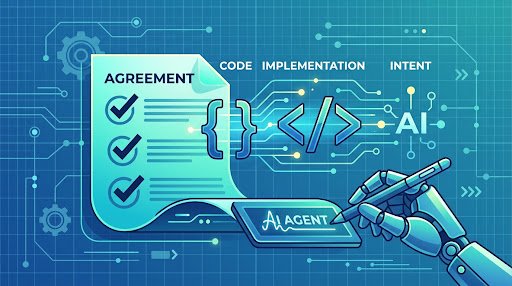
AI coding agents can produce code quickly, but speed does not resolve ambiguity. A request such as “add SSO,” “clean up the dashboard,” or “fix checkout” leaves decisions unstated: what may change, which architecture must remain intact, how success will be demonstrated, and what happens if release signals deteriorate.
AI coding agent engineering contracts turn those decisions into explicit delivery terms. They are repository-aware task specifications that define intent, boundaries, constraints, evidence, and release controls before implementation begins. Their purpose is not to replace engineering judgment. It is to make that judgment visible and reviewable.
This is useful for Java and React teams because a change that looks reasonable in isolation can still conflict with authorization, service boundaries, API compatibility, state-management conventions, or operational controls. Repository guidance can define project conventions, code organization, and commands to run. Agent output can also include citations, terminal logs, and test results for review before integration. OpenAI describes these forms of repository guidance and verification for Codex. GitHub similarly documents repository instructions for coding standards, structure, build procedures, and tests. GitHub Docs
Start with a contract, not a broad prompt
A prompt communicates a desired change. A contract states what the team will accept as a completed change. The distinction is practical.
“Add a bulk deactivate endpoint” identifies a possible feature, but not its authorization model, affected records, response behavior, compatibility requirements, release method, or reversal path. A repository may answer some of those questions, but a task should not depend on undocumented assumptions when the decisions affect behavior or risk.
An engineering contract creates a common review frame before code creates momentum around an accidental design. It tells the agent where discretion is appropriate and where it must stop and escalate. It also gives the reviewer a direct way to compare the resulting patch with the delegated outcome.
A compact framework for delegation
Use the following six sections for routine work. The headings are intentionally simple so teams can adapt them to their existing issue templates, pull-request forms, or repository instructions.
- Outcome: State the user, business, or operational behavior that must be true after delivery.
- Scope: Name included modules, routes, packages, tests, and explicit exclusions.
- Constraints: Specify architecture rules, security controls, data ownership, dependencies, and established local patterns.
- Acceptance: Define observable behavior and the tests or checks that demonstrate it.
- Failure behavior: Cover authorization failures, validation, loading and error states, concurrency concerns, and compatibility where relevant.
- Release controls: State rollout, observability, rollback, and escalation rules when the change reaches production-facing behavior.
The framework is an editorial operating model rather than a formal standard. Its value is consistency: every task can answer the same questions. What outcome is intended? What boundaries are protected? What proof is required? Who decides whether the change proceeds or is reversed?
What a contract changes
| Dimension | Vague request | Engineering contract |
|---|---|---|
| Outcome | “Add account deactivation.” | “Authorized administrators can deactivate an active account and receive a clear confirmation.” |
| Scope | Agent decides affected layers. | Names the API, service, UI route, tests, and explicit exclusions. |
| Architecture | “Use best practices.” | Requires existing authorization boundaries, service conventions, and compatibility policy. |
| Evidence | “Make sure tests pass.” | Lists relevant scenarios, required commands, results, and limitations. |
| Release | No release behavior stated. | Defines the rollout method, owner, signals, and rollback action where applicable. |
Write behavior before naming implementation
Begin with externally meaningful behavior. This keeps the requested implementation from becoming the objective when it is only one possible mechanism.
Java: preserve domain and authorization boundaries
For a Spring-based service, avoid delegating only “add a deactivate method to UserController.” A stronger outcome is: “An organization administrator may deactivate an active member in their own organization, and protected operations must no longer be authorized for that member after the established policy takes effect.”
The contract can then set constraints without prescribing every line of code: use the existing authorization boundary rather than controller-local role checks; retain tenant filtering at the project’s established boundary; preserve the existing error response format; and use the project’s established audit mechanism if one applies. OWASP recommends that reviewers understand the architecture and business requirements, identify affected components and security controls, and examine authorization, workflow integrity, state transitions, and rollback mechanisms. OWASP Secure Code Review Cheat Sheet
Do not mandate a transaction annotation, database query, or class name unless the repository already establishes that choice or the decision is essential to the work. Prefer invariants: an administrator cannot alter a member outside their organization; repeated requests have documented behavior; and any existing consistency expectations remain intact.
React: specify user-observable states
For React, “add a deactivate button” is equally incomplete. The contract should describe the user flow: the control is available only to permitted administrators; confirmation precedes the request if that is the existing product pattern; pending state prevents duplicate submission; a failure leaves the screen usable and exposes an accessible error; and success updates the visible member state without leaving a stale action available.
Require behavioral tests for the interaction and asynchronous result, rather than only a snapshot or direct state assertion. React documents act as the mechanism for flushing rendering and interaction updates before assertions, including asynchronous behavior. React documentation for act The particular test library remains a repository decision; the contract should describe the behavior that must be demonstrated.
Bound scope to protect the architecture
Every contract needs a scope section. It protects the system from unapproved expansion by stating what may change, what must not change, and which existing interfaces remain stable.
- Included: affected service, endpoint, UI route, tests, and configuration or documentation that must change with the feature.
- Excluded: migrations, dependency upgrades, API version changes, broad refactors, and unrelated cleanup unless separately approved.
- Compatibility: public API fields, events, error shapes, localization keys, accessibility behavior, and existing consumers that must continue to work.
- Ownership: the team, system owner, or reviewer required for decisions that cross a boundary.
Stable engineering rules should live in version-controlled repository guidance rather than being repeated in every task. GitHub documents repository custom instructions and specialized agents, including workflows for reproducing a bug with a failing test, fixing it, and verifying existing tests. GitHub Docs on project customization Use repository guidance for durable defaults and the task contract for decisions unique to the current change.
Make acceptance criteria produce reviewable evidence
“Done when tests pass” is insufficient unless the relevant behavior and checks are identified. A passing but unrelated test suite does not demonstrate the requested outcome.
NIST’s DevSecOps reference model describes automated testing against functional, non-functional, and security requirements; collection of evidence that required tests passed; and rollback procedures before release. NIST DevSecOps Notional Reference Model NIST’s Secure Software Development Framework also recommends defined security criteria, their inclusion in a Definition of Done, automated evidence gathering, and records for approvals, rejections, and exceptions. NIST SP 800-218 SSDF
For an agent task, ask for a small evidence bundle:
- Acceptance criteria mapped to tests, or a documented reason automated verification is unavailable.
- The repository’s required build, test, lint, static-analysis, and security commands.
- Actual results, including failures and checks not run.
- A concise changed-file summary and rationale for consequential architectural decisions.
- Assumptions, unresolved risks, and approvals still needed from humans.
Evidence does not replace review. It makes review faster because the reviewer can evaluate the change against the agreed intent instead of reconstructing the agent’s assumptions from the diff alone.
Decide release and rollback before implementation
Not every task needs a production rollout plan. A documentation correction or isolated internal refactor may not. Changes affecting authorization, data handling, customer workflows, billing, or other production-facing paths should state their transition controls before implementation starts.
A contract can require an existing feature flag, relevant failure logging, and a named release decision-maker. Google’s SRE Workbook describes a canary as a partial, time-limited deployment evaluated before further rollout. It also notes that routing-based rollback can reverse a cutover without downtime. Google SRE Workbook: Canarying Releases
Write rollback as an action the team can perform: disable an established flag, restore a prior route, or halt rollout pending review. Do not invent thresholds where the service has no established baseline. Instead, identify the decision owner and the signals they will use.
A reusable contract template
Outcome
[User or system behavior that must be true after delivery.]

Scope
Included: [modules, routes, packages, tests]
Excluded: [explicit non-goals]
Compatibility: [API, data, UI, event, and operational contracts]

Constraints
- Follow [repository guidance path or established pattern].
- Preserve [architecture and ownership boundaries].
- Apply [authorization, validation, audit, accessibility, or performance constraints].

Acceptance criteria
- Given [precondition], when [action], then [observable result].
- Given [failure or edge case], when [action], then [safe behavior].
- Required verification: [exact commands and test scenarios].

Evidence to return
- Changed files and rationale
- Test and analysis results, including anything not run
- Assumptions, limitations, and approvals needed

Release and rollback
- Rollout method: [flag, canary, normal release, or not applicable]
- Observe: [signals and owner]
- Roll back by: [concrete action]
- Escalate when: [decision boundary]
Use the contract in review
Engineering leads can make contracts operational with a short review checklist. Confirm that the outcome is understandable outside the implementation team; verify that exclusions are explicit for changes likely to spread across services or UI areas; and ensure that state-changing work includes an unhappy-path criterion.
Reviewers should also check that the returned evidence distinguishes passing checks from checks that were not run. An agent should escalate rather than independently decide to change a public API, introduce a dependency, run a migration, or weaken a security control. For production-facing work, the contract should identify the rollout and rollback decision before the patch is accepted.
After delivery, retain durable lessons in repository guidance and keep task-specific decisions with the change record. This separates reusable conventions from the intent and risk decisions unique to a particular implementation.
FAQ
Are AI coding agent engineering contracts only for large changes?
No. Small tasks can use a compressed version: outcome, scope, one or two acceptance criteria, and required checks. The contract should grow with risk and cross-system impact.
Should the contract dictate the exact implementation?
Usually not. Specify invariants and existing patterns. Prescribe implementation details when compatibility, security, or an already-approved technical decision requires them.
Who writes the contract?
The accountable engineer owns the technical boundaries. Product, design, security, and operations contributors provide requirements when their systems or decisions are affected.
Can repository instructions replace task contracts?
No. Repository instructions provide durable defaults. A task contract supplies the change-specific intent, scope, evidence, and release decision for the work at hand.
Sources
- Introducing Codex | OpenAI
- Customize Copilot for your project | GitHub Docs
- NIST DevSecOps Notional Reference Model
- Secure Software Development Framework (SSDF) Version 1.1 | NIST
- Canarying Releases | Google SRE Workbook
- act | React
- Secure Code Review Cheat Sheet | OWASP
Editorial note: AI assisted with research and drafting. Sources were selected for verification.

Full-Stack Developer & Solutions Architect · Casablanca, Morocco
8+ years building Java/Spring Boot/Angular enterprise solutions. Former Senior Software Engineer at NTT Data and Satec. Authorized Google Workspace and Microsoft 365 Partner for Morocco.