





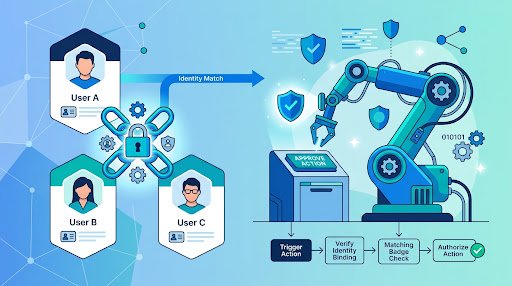
AI automation identity binding prevents an AI-enabled workflow from sending, posting, sharing, or updating through the wrong connected account. The control is straightforward: establish one authorized execution identity before the model plans an action, keep that identity fixed for the run, and validate it again immediately before a provider write occurs.
An LLM can help prepare a message, summarize a document, or propose a workflow action. It should not decide which OAuth connection, tenant, mailbox, Shared Drive, or business account will carry out that action. Those choices are authorization decisions. They belong in deterministic application logic and policy, not in model output.
This distinction matters even when the requested action is otherwise valid. A message may be correctly written but sent from an unintended mailbox. A file may be correctly selected but shared from the wrong Workspace context. A workflow may publish the intended content through the wrong business account. The operational result is still wrong.
Start With the Execution Identity
Bind identity at the workflow entry point, before constructing prompts and before exposing any action tool to the model. The binding should come from trusted state such as an authenticated session, a signed request, a workspace membership check, or a configuration selected by an authorized operator.
Natural-language instructions are not a sufficient source of truth. Requests such as “send this from my work account” or “use the company drive” can be useful context for a user interface, but they do not establish an authorization boundary. The system must resolve the approved account using trusted identifiers.
A server-side execution context can contain the following fields:
actor_id: the authenticated user or service requesting work.organization_id: the workspace, customer, or business unit that owns the action.provider: the external service used for the action.tenant_id: the provider account boundary associated with the organization.credential_ref: an opaque reference to an approved credential.allowed_resources: the resources the workflow may use, such as named mailboxes, sites, drives, or channels.operation_policy: permitted actions, approval requirements, and audit expectations.
The authoritative context stays in the orchestration layer. The model may receive limited display information when it is needed to prepare an understandable draft or approval request, but it should not receive tokens, credential inventories, or free-form authority to choose an account.
Why Account Choice Is a Security Boundary
Connected automation systems commonly have more than one credential available: separate organizations, test and production identities, individual user accounts, or service identities with different scopes. Treating those choices as normal tool parameters lets a probabilistic component influence the security context of a downstream write.
OWASP describes excessive agency as a situation where an LLM-enabled system is given more functionality, permissions, or autonomy than the task requires. Its recommended mitigations include minimizing permissions, limiting available functionality, and using human confirmation where an action is consequential. That reasoning applies directly to account selection: an agent should not be granted authority to establish the identity under which it acts. OWASP LLM06 guidance
The confused deputy problem offers another useful design lens. A trusted intermediary may have legitimate authority, yet be induced to apply that authority to the wrong account or resource. AWS recommends contextual controls that bind a request to the intended source and account instead of relying only on a general request. For AI automation, the equivalent is carrying a fixed identity context to the execution boundary and checking it there. AWS confused deputy guidance
Use Tenant-Aware Tool Contracts
The strongest practical control is a narrow tool contract. Avoid tools that accept account-selection inputs alongside business content. For example, a generic tool such as send_email(account, recipient, subject, body) allows the account argument to become part of model-controlled behavior.
A bound alternative is a tool such as prepare_bound_email(draft) followed by a deterministic execution adapter. The adapter resolves the approved credential, mailbox, tenant, and resource internally from the execution context. It rejects an override rather than treating it as a preference.
| Weak design | Failure mode | Bound design |
|---|---|---|
| Model chooses a connected account | An ambiguous request selects the wrong identity | Trusted workflow entry resolves one credential reference |
| Tool accepts mailbox, tenant, or drive ID | Model output can switch resources | Adapter derives resources from a policy allowlist |
| Shared broad credential for all runs | Large cross-user or cross-organization blast radius | Credential context is isolated per authorized user or workspace |
| Write immediately after model output | No review of the final identity and target | Draft, approval when required, then deterministic execution |
| Success-only logging | Identity use cannot be reconstructed | Record identity binding, policy result, target, and provider response |
In this model, content inputs can remain model-assisted. Authorization inputs cannot. The model may propose a recipient, message body, file metadata, or a requested operation. It must not set tenant_id, credential_ref, mailbox_id, provider endpoint paths, or an impersonation subject.
Applying the Pattern in n8n
In n8n, credentials should be treated as workflow security configuration, not as runtime data supplied by an AI Agent node, webhook payload, or chat message. A workflow that acts for multiple users or organizations needs a trusted lookup that resolves the approved credential context from the authenticated requester and associated workspace.
n8n documents end-user credentials as a mechanism for connecting actions to an individual user authorization context instead of relying on one shared credential. This is relevant when a workflow needs to operate for different people while retaining a distinct authorization context for each execution. n8n end-user credentials documentation
Place a deterministic validation step immediately before every state-changing provider action. That step should confirm that the run has one bound organization and tenant, that the credential belongs to that context, that the resource is approved for the requested operation, and that the policy permits the action.
Separate production, staging, and test identities through explicit configuration. Human-readable credential names may help operators, but names alone are not an identity control. The durable relationship is a server-side mapping among organization, provider tenant, approved credential reference, and allowed resources.
Microsoft 365 and Google Workspace Controls
Microsoft Graph distinguishes delegated permissions, where an application acts on behalf of a signed-in user, from application permissions, where it can act without a signed-in user. Those permission models have different effective reach, so the choice should match the automation’s actual job and use the least privilege needed. Microsoft Graph permissions overview
Do not let a model construct a Graph path that identifies a mailbox, user, site, or other target resource. The application should resolve the approved target from its bound policy context and construct the provider request in code. Where broader application authority is required, restrictions on the intended tenant and allowed resource remain necessary outside the model.
Google Workspace service accounts can use domain-wide delegation after an administrator authorizes scopes and the application impersonates a user. Google’s documentation describes application-set subject identity in this flow and the role of authorized scopes. Google OAuth 2.0 service-account documentation
That subject is an authorization input, not model output. Backend code should map a trusted business context to an allowed service-account configuration or impersonated subject, validate the expected Workspace domain, and limit scopes to the job being performed. Apply the same approach to Shared Drives: resolve approved drive identifiers from policy rather than from a model-generated name, label, or URL.
Make Approval Bind the Final Action
Approval helps only when the reviewer can see the identity that will execute the action. An approval view should show the source tenant, sender or publishing account, target resource, recipient or audience, and a concise content preview.
The reviewer should approve an immutable action package. Store a digest of the bound identity, target, action parameters, and applicable policy version at approval time. Recompute it before execution. If the tenant, account, resource, content, or policy-relevant values changed, invalidate the approval and return the action to review.
Some low-risk internal actions may be eligible for policy-based automatic execution. External communication, sharing, permission changes, and other consequential actions are candidates for explicit approval. The exact threshold is a business decision, but the decision should be encoded in policy rather than inferred by the LLM.
Audit and Test the Boundary
A successful execution record is not enough. An audit trail should establish who initiated the work, which organization owned it, which credential reference was bound, which tenant and resource policy selected, what was proposed, whether approval was required, and what the provider returned.
Keep secrets and access tokens out of general logs. Use opaque credential references, correlation IDs, and protected audit storage. DPoP can add sender-constraining protection where supported: RFC 9449 specifies proof-of-possession mechanisms for certain OAuth tokens. It does not decide whether a particular tenant, mailbox, or drive is authorized for a business action, so it complements rather than replaces application-level binding.
Integration tests should prove that adapters cannot bypass policy. Use isolated provider test contexts or mock adapters that record the identity used for a request. Assert that an Organization A request cannot execute with Organization B’s credential even if model output names B’s resource.
Include negative cases for a missing tenant binding, stale credential reference, arbitrary provider resource path, unapproved impersonation subject, and an approval whose target changed after review. Each should fail before a provider write. Also test the allowed path and verify that its audit record includes the expected binding and approval reference.
FAQ
Is an account selector in the chat interface enough?
No. It may be useful interface context, but it becomes authoritative only when the selection is converted into a trusted server-side binding that every write adapter validates.
Do delegated OAuth permissions eliminate wrong-account actions?
No. Delegated permissions can narrow effective rights to those of a signed-in user, but the workflow still must bind the correct user and target before execution.
Should the LLM see account names?
Only when that information helps produce a clear draft or review screen. It should not receive secrets, unrestricted credential lists, or authority to select a connection.
Does DPoP prevent cross-account mistakes?
No. DPoP can sender-constrain supported OAuth tokens, but it does not determine which business account or resource is permitted for a specific action.
Sources
- OWASP Top 10 for LLM Applications: LLM06 Excessive Agency
- n8n Documentation: End-User Credentials
- Microsoft Graph Permissions Overview
- Google OAuth 2.0 for Service Accounts
- AWS IAM: Cross-Service Confused Deputy Prevention
- RFC 9449: OAuth 2.0 Demonstrating Proof-of-Possession
Editorial note: AI assisted with research and drafting. Sources were selected for verification.

Full-Stack Developer & Solutions Architect · Casablanca, Morocco
8+ years building Java/Spring Boot/Angular enterprise solutions. Former Senior Software Engineer at NTT Data and Satec. Authorized Google Workspace and Microsoft 365 Partner for Morocco.