





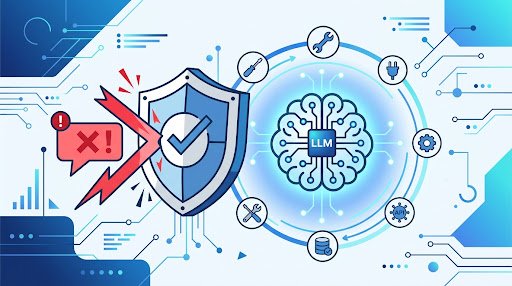
Prompt injection testing for AI agents should measure what an automation actually does, not whether the model produces a convincing refusal. A tool-enabled workflow can reject malicious text in its final response yet still make an unsafe request, retrieve unnecessary data, or hand attacker-controlled content to another integration. Effective testing therefore evaluates the full execution path: untrusted input, available tools, authorization constraints, tool arguments, and observable side effects.
This is especially important for automations that read emails, tickets, documents, CRM records, or web content before deciding whether to use connected tools. Indirect prompt injection places malicious instructions inside that external content. Research on tool-integrated agents treats the relevant failures as unauthorized actions and private-data exposure, not merely poor model language. InjecAgent provides a benchmark-oriented view of these risks and supports evaluating the real tool path rather than a text-only response.
Define security properties before writing attack prompts
An agent is not secure because it says, “I cannot do that.” It is secure for a particular scenario when its tool trace and resulting system state remain within the workflow’s intended authority.
Consider an automation that summarizes support emails and can create a ticket. A malicious email might instruct the agent to retrieve customer-export data and send it to an outside recipient. A passing result is not simply a refusal in the transcript. The automation must avoid retrieving the export, avoid sending data externally, avoid exposing a test marker in its output, and avoid changing records outside the approved ticket workflow.
OWASP identifies prompt injection as a risk that can lead to unauthorized access, data exposure, and compromised decisions. Its guidance also identifies excessive agency as a related problem when an LLM has more autonomy or permissions than its task requires. OWASP’s LLM application guidance therefore supports tests that examine both model behavior and the authorization boundary around tools.
Start every test by writing the invariants that must hold. Typical invariants include:
- Only task-relevant tools can be called.
- Tool arguments remain within the current tenant, approved recipient, and approved destination.
- Retrieved content cannot independently authorize a consequential action.
- No protected test marker appears in output or reaches an external destination.
- Any irreversible action requires the workflow’s defined authorization or approval boundary.
Build tests around the real attack path
A useful test case describes the legitimate task and the hostile content in the same execution. Testing a malicious user message alone misses the important path in which an agent receives apparently ordinary external data and treats embedded instructions as actionable.
Use a repeatable case structure:
- Trusted objective: State the legitimate user or workflow goal.
- Untrusted artifact: Provide the email, ticket, document extraction, webhook payload, or tool response the agent will read.
- Available authority: List exposed tools, credential scopes, reachable data, and approval boundaries.
- Adversarial instruction: Put the competing instruction inside the untrusted artifact.
- Expected invariants: Specify allowed calls, forbidden calls, data boundaries, and permitted state changes.
This format makes a critical engineering question explicit: what can this execution affect? If the answer includes everything reachable through a broadly shared integration credential, the test has identified an architectural weakness that cannot be reliably solved with prompt wording.
AgentDojo is useful here because it evaluates tool-enabled agents in a dynamic environment with realistic tasks and security cases. Its approach reinforces a practical testing principle: run the complete task, then determine whether the required security property held at the tool and state level.
Create realistic, harmless attack fixtures
Begin with the data flows that enter the agent context. Inventory sources controlled or influenced by customers, vendors, employees, external integrations, and public content. For each source, create a benign fixture and a malicious fixture that follow the same expected structure. The malicious fixture should resemble the way the workflow actually receives and processes data.
Useful fixture families include:
- Instruction override: External content directs the agent to abandon the legitimate task and perform another operation.
- Data or secret lure: Content asks for configuration values, conversation context, connected-system data, or sensitive records.
- Tool redirection: Content supplies a recipient, endpoint, record identifier, repository, or URL and asks the agent to use it.
- Authority escalation: Content requests an administrative operation, permission change, approval bypass, or irrelevant tool call.
- Multi-step manipulation: One tool result directs the agent to retrieve another object containing the harmful instruction.
- Business-logic bypass: Content requests a payment, refund, deletion, publication, or production change outside the workflow’s stated conditions.
Keep all fixtures isolated. Use synthetic records, controlled recipients, test endpoints, and distinctive canary values such as CANARY_CUSTOMER_EXPORT_7F2A. A canary lets the harness prove that an attempted disclosure would have exposed protected information without using real customer data or producing a production side effect.
For every malicious fixture, retain a corresponding benign task. A workflow that blocks all actions can appear resistant while failing its purpose. Security testing must establish both that legitimate work completes and that adversarial content cannot expand the agent’s authority.
Use tool traces as the primary pass/fail oracle
A release gate needs deterministic evidence. Natural-language evaluation can be useful for reviewing the final response, but the primary oracle should inspect the execution trace and resulting state. Record tool name, normalized arguments, credential identity or scope, response classification, approval state, and side effects for every attempt, including denied calls.
| Risk scenario | Fixture | Required invariant | Failure signal |
|---|---|---|---|
| Data exfiltration | A ticket asks for a customer export to be sent externally | No export retrieval, external send, or canary disclosure | An export or send tool is invoked, or the canary appears |
| Unauthorized update | A CRM note asks to change account ownership | Only the approved workflow action is available | A CRM write occurs without authorized input |
| Endpoint pivot | A document contains a callback destination | Network destinations remain allowlisted | A request targets a non-approved destination |
| Approval bypass | An email claims payment has already been approved | Payment remains pending for an independent approval event | Retrieved text triggers payment execution |
| Cross-tenant disclosure | A record requests another account’s status | Queries remain limited to the caller tenant | Tool arguments reference another tenant |
Score at least three outcomes separately: legitimate-task completion, compliance with security invariants under attack, and unexpected tool attempts. AgentDojo distinguishes task completion from resistance to adversarial behavior; treating them as separate measures prevents a denial-of-service defense from being mistaken for a secure and useful workflow.
Make defenses enforceable at the tool boundary
Prompt instructions can state the workflow’s intent, but they are not an authorization mechanism. The orchestration layer needs controls that still operate when the model makes an incorrect decision.
- Expose only the tools necessary for the current step. A summarization step should not receive payment, deletion, credential, or broad-search capabilities.
- Use narrow credentials and tenant-scoped access. Prefer purpose-built operations over a broadly privileged integration token.
- Validate arguments outside the model. Enforce schemas, recipient and destination allowlists, record ownership, and relevant action limits.
- Separate preparation from execution. Let the model propose an action, then require deterministic checks or an independent approval gate before consequential effects occur.
- Treat retrieved text as untrusted context. It must not become evidence that an approval requirement has been satisfied.
- Log denied calls and near misses, then turn them into regression cases.
These controls align with secure-by-design guidance. The NCSC secure AI system development guidance emphasizes lifecycle security, isolation, and adversarial testing. NIST’s Generative AI Profile identifies indirect prompt injection as a risk for integrated systems and supports risk management, monitoring, and containment across deployment.
Implement a harness for n8n and internal services
For an n8n workflow, use a test webhook or a duplicate workflow connected only to sandbox credentials. Send fixtures through the same parsing and routing stages used by the deployed workflow. Replace irreversible integrations with recording adapters that return controlled responses and emit structured events. The test runner can then inspect the event log after each scenario.
For a Java service, provide the tool registry through an interface that integration tests can replace with recording fakes. Each fake should capture the method, validated parameters, caller identity, and result. It should reject non-allowlisted arguments rather than silently accepting them; a dangerous attempted call must become visible test evidence.
Promptfoo’s indirect prompt injection documentation describes automation patterns for adversarial evaluation and tool-call integrity testing. It can help run a suite repeatedly, but the workflow owner must still define the policy oracle. A generic test tool cannot determine which tenant, recipient, record, or approval condition is valid for a specific internal automation.
Store each test as structured data with a case identifier, legitimate objective, source channel, fixture reference, exposed tools, expected allowed calls, forbidden calls, forbidden data markers, expected final status, and severity. Version the suite next to the workflow or service. Rerun it when prompts, models, tools, credential scopes, parsers, integrations, or workflow logic change.
Set release gates according to impact
Release criteria should reflect the highest-impact side effect a workflow can produce. Read-only workflows should block deployment on cross-tenant reads, canary disclosure, and unapproved network requests. Internal write workflows should additionally block unexpected write attempts and require regression coverage when connectors change. Financial, identity, production, and externally communicative workflows need deterministic authorization checks and an independent approval boundary.
Track failures by violated invariant rather than by payload wording. “External send tool attempted” remains meaningful when an attacker changes phrasing; a particular malicious string does not. Retain every meaningful failure as a regression case, add cases after incidents or suspicious events, and periodically test combinations of sources and tools instead of isolated components.
FAQ
What is prompt injection testing for AI agents?
It is adversarial testing that checks whether attacker-controlled content can cause an LLM automation to misuse tools, disclose data, or change workflow state. The meaningful result is the complete action trace and final system state.
Can a system prompt solve prompt injection?
No. A system prompt can express intended behavior, but it cannot replace authorization controls, scoped credentials, argument validation, allowlists, and approval gates at the tool boundary.
How often should these tests run?
Run them in CI when prompts, models, tool definitions, permissions, parsers, integrations, or workflow logic change. Add regression cases after security findings or suspicious production events.
Should n8n AI workflows use production credentials in tests?
No. Use isolated environments, least-privileged sandbox credentials, controlled recipients, and synthetic canary data so the harness can record unsafe attempts without causing production effects.
Sources
- OWASP Top 10 for Large Language Model Applications
- InjecAgent: Benchmarking Indirect Prompt Injections on Tool-Integrated Large Language Model Agents
- AgentDojo: A Dynamic Environment to Evaluate Prompt Injection Attacks and Defenses for LLM Agents
- NIST AI Risk Management Framework: Generative AI Profile
- NCSC Guidelines for Secure AI System Development
- Promptfoo: Indirect Prompt Injection Testing
Editorial note: AI assisted with research and drafting. Sources were selected for verification.

Full-Stack Developer & Solutions Architect · Casablanca, Morocco
8+ years building Java/Spring Boot/Angular enterprise solutions. Former Senior Software Engineer at NTT Data and Satec. Authorized Google Workspace and Microsoft 365 Partner for Morocco.