





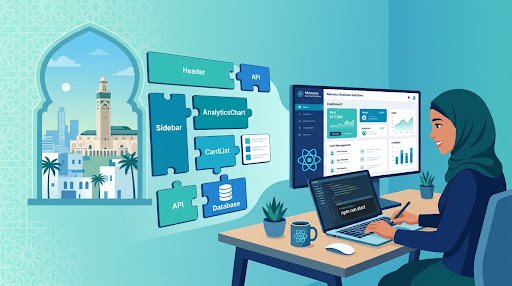
What Is React and Why It Dominates Modern Web Development
React development Morocco has emerged as one of the fastest-growing tech specialisations in the North African region. Built by Meta (formerly Facebook) and released as open source in 2013, React is a JavaScript library for building user interfaces — particularly single-page applications where the user interface needs to update dynamically without full page reloads. Today it powers everything from small startup MVPs to enterprise-grade platforms used by millions of users every day.

React’s core philosophy is simple: break your UI into small, reusable pieces called components, and let the library handle efficiently updating the actual DOM whenever your data changes. This virtual DOM diffing approach makes React exceptionally fast for complex, data-driven applications. According to the official React documentation, the library is designed to be incrementally adoptable, meaning you can start using it on a single widget and gradually migrate an entire application.
For Moroccan businesses looking to compete in a digital-first world, adopting React means getting access to a thriving global ecosystem: thousands of open-source packages, a massive community of developers, excellent tooling, and long-term support backed by Meta’s engineering team. In this article, Mohamed CHAMI — a seasoned React specialist based in Casablanca — walks you through 7 expert techniques that define professional React development in Morocco and beyond.
Technique 1: Mastering React Hooks for Cleaner Components
Introduced in React 16.8, Hooks revolutionised how developers write React code. Before Hooks, state and lifecycle logic were only available inside class components — which led to complex, hard-to-test codebases. Hooks allow you to use state, side effects, context, and more directly inside functional components, resulting in far cleaner and more composable code.

The two most fundamental Hooks are useState and useEffect. useState lets you add reactive state variables to a function component. Every time the state changes, React re-renders the component to reflect the new value. useEffect replaces the lifecycle methods (componentDidMount, componentDidUpdate, componentWillUnmount) from class components. You use it to run side effects — such as fetching data from an API, subscribing to events, or updating the browser title — after every render or only when certain dependencies change.
Beyond these basics, mastery of custom Hooks is what separates junior developers from senior React engineers. A custom Hook is simply a JavaScript function whose name starts with use and which calls other Hooks internally. By extracting shared logic into custom Hooks (for example, useFetch, useLocalStorage, or useWindowSize), you eliminate code duplication across components and make your business logic independently testable. This technique is particularly valuable in Moroccan enterprise projects where multiple teams might work on different features simultaneously.
Other important built-in Hooks include useCallback (to memoize functions), useMemo (to memoize computed values), useRef (to persist mutable values without triggering re-renders), and useContext (to consume context without prop drilling). A professional React developer in Morocco will know exactly when to reach for each of these tools.
Technique 2: Advanced State Management with Context API and Redux
One of the biggest challenges in any React application is managing state across many components. When data needs to be shared between components that are not parent-and-child, passing props through many intermediate layers — known as prop drilling — becomes unmanageable. Expert React development in Morocco relies on two primary solutions: the Context API (built into React) and Redux (a popular external library).
The Context API is React’s native solution for sharing global state. You create a Context, provide a value at the top of your component tree, and any descendant component can consume that value without receiving it as a prop. This is ideal for relatively simple global state such as authentication status, language/locale, or theme preferences. The Context API works best for state that does not change frequently, because every component consuming the context will re-render when the context value changes.
For more complex state management — such as e-commerce carts, multi-step form workflows, or real-time data dashboards — Redux remains the industry standard. Redux enforces a unidirectional data flow: components dispatch actions, reducers compute the next state, and the store notifies subscribers of the change. Redux DevTools makes debugging production issues dramatically easier because you can replay every action that led to a bug. Modern Redux uses the Redux Toolkit package, which greatly reduces boilerplate and includes best practices out of the box. Mohamed CHAMI’s projects for Moroccan clients frequently leverage Redux Toolkit combined with RTK Query for efficient server-state management and API caching.
An emerging alternative gaining traction is Zustand — a lightweight state management library that offers a simpler API than Redux while being more powerful than the Context API. For medium-sized Moroccan web applications, Zustand can be the ideal balance between simplicity and capability.
Technique 3: Scalable Component Architecture
Writing React components is easy. Writing React components that remain maintainable at scale — across teams, across years, and across changing business requirements — is a genuine engineering discipline. A well-structured component architecture is what separates a professional React project from one that becomes unmaintainable within six months.

The Atomic Design methodology, popularised by Brad Frost, provides an excellent mental model for React component organisation. Components are divided into five levels: atoms (basic HTML elements wrapped in React), molecules (groups of atoms forming simple UI units), organisms (complex UI sections), templates (page layouts), and pages (specific instances of templates with real data). By following this hierarchy, teams in Morocco and worldwide can work on different levels independently without conflicts.
Another critical architectural concern is the separation of presentation and container components (also called dumb and smart components). Presentation components receive data and callbacks via props and only concern themselves with how things look. Container components manage state and side effects and pass data down to presentation components. This separation makes components significantly easier to test and reuse.
Folder structure matters too. In large React codebases, grouping files by feature (also called feature-sliced design) rather than by file type (all components together, all hooks together) scales much better. Each feature folder contains its own components, hooks, services, and tests. This is the structure Mohamed CHAMI uses on all enterprise React development Morocco projects to ensure long-term maintainability.
Technique 4: Performance Optimization Strategies
A dynamic web app that loads slowly or stutters during interactions will drive users away — no matter how beautiful the design. Performance optimisation is therefore a non-negotiable part of professional React development in Morocco. There are several key strategies that every expert React developer should master.
Code splitting and lazy loading allow you to break your JavaScript bundle into smaller chunks that are loaded on demand. Using React’s built-in React.lazy() and Suspense, you can defer loading entire routes or heavy components until the user actually navigates to them. This dramatically reduces the initial bundle size and improves Time to Interactive (TTI) scores — a critical metric for Moroccan businesses competing for mobile users on slower connections.
Memoisation prevents unnecessary re-renders. React.memo wraps a component so it only re-renders when its props change. useMemo and useCallback inside components prevent expensive calculations and function references from being recreated on every render. Used judiciously — because over-memoisation can actually hurt performance — these tools are essential in data-heavy applications.
Virtualisation is critical for rendering large lists. Libraries like react-window and react-virtual render only the items currently visible in the viewport, rather than mounting all thousands of items in the DOM. For Moroccan e-commerce platforms displaying hundreds of products, or admin dashboards with large data tables, virtualisation is indispensable.
Finally, image optimisation and proper use of modern JavaScript features such as async/await, optional chaining, and the Intersection Observer API can substantially reduce render times and improve perceived performance across all devices.
Technique 5: Dynamic Routing with React Router
Single-page applications built with React need a robust routing solution to give users the experience of navigating between pages without a full browser refresh. React Router is the de facto standard for client-side routing in the React ecosystem. With version 6 (and the latest v6.4+ data APIs), React Router offers a declarative, component-based routing system that integrates cleanly with modern React patterns.
Professional React development in Morocco commonly requires several advanced routing features. Nested routes allow you to compose layouts with shared navigation bars and sidebars while swapping only the content area. Dynamic route parameters (e.g., /products/:id) let you build detail pages for any entity — products, users, articles — from a single component. Protected routes (also called private routes) guard pages behind authentication checks, redirecting unauthenticated users to a login page. Lazy-loaded routes, combined with React Router’s Suspense integration, enable the code splitting described above.
React Router v6.4 introduced a new loader and action API inspired by Remix (a full-stack React framework). Loaders allow you to fetch data for a route before the component renders, eliminating loading spinners and improving perceived performance. Actions handle form submissions in a RESTful way. These patterns are increasingly adopted in Moroccan enterprise React projects that prioritise user experience.
Technique 6: Testing React Applications Effectively
Testing is one of the most overlooked aspects of React development, yet it is what separates applications that can be confidently deployed from those that break with every new feature. A professional React developer in Morocco will build a comprehensive test suite consisting of unit tests, integration tests, and end-to-end tests.
The standard testing stack for React includes Jest (the test runner and assertion library) and React Testing Library (a utility for testing React components in a way that resembles how users actually interact with them). React Testing Library encourages testing based on user-visible behaviour rather than implementation details. You query elements by accessible roles, labels, or text — not by CSS classes or component internals. This results in tests that are much less brittle and much more meaningful.
For end-to-end testing — automating a real browser to simulate complete user journeys — Cypress and Playwright are the leading tools. Running end-to-end tests in a CI/CD pipeline ensures that critical workflows (such as checkout flows on Moroccan e-commerce sites or registration forms on SaaS platforms) never regress undetected. Mohamed CHAMI integrates automated testing into every software development project in Morocco to guarantee production-ready quality.
Technique 7: TypeScript Integration for Type-Safe React Apps
TypeScript has become the professional standard for large React codebases. By adding static types to JavaScript, TypeScript catches entire classes of bugs at compile time — before code ever reaches production. For React specifically, TypeScript allows you to type component props, state, context values, custom Hook return types, and API response shapes. When a developer tries to pass the wrong type of data to a component, the TypeScript compiler flags it immediately.
The productivity benefits extend beyond bug prevention. TypeScript enables powerful IDE autocompletion and inline documentation. When Mohamed CHAMI delivers React development Morocco projects to clients, TypeScript is the default choice for all medium and large applications because it dramatically reduces maintenance costs over time. New team members can onboard faster because the types serve as living documentation of how every piece of the application works.
The Create React App template includes TypeScript support out of the box, and Vite — the modern, lightning-fast React build tool that has largely replaced Create React App — also offers a TypeScript template. Configuring strict TypeScript settings (strict: true in tsconfig.json) from the start of a project is a best practice that pays dividends throughout the application’s lifecycle.
React Development in the Moroccan Business Context
Morocco is rapidly positioning itself as a technology and innovation hub for Africa and the Mediterranean region. With major investments in digital infrastructure, a growing pool of university-educated tech talent, and favourable time-zone alignment with European markets, Moroccan businesses and international companies establishing Moroccan tech centres are increasingly demanding world-class web development expertise.

For Moroccan companies in retail, finance, healthcare, and logistics, React-powered web applications unlock genuine competitive advantages. E-commerce platforms built with React deliver faster page transitions and smoother checkout flows than traditional server-rendered sites. Internal tools and dashboards built with React enable operations teams to process more information in less time. Customer portals built with React improve satisfaction and reduce support burden. Every major Moroccan bank and telco has already invested heavily in React or comparable modern frontend frameworks.
There are also unique local considerations. Moroccan users are predominantly mobile-first, which makes React performance optimisation — particularly code splitting and image optimisation — even more critical than in markets with universal broadband access. Arabic and French language support (with right-to-left layout for Arabic) requires careful internationalisation (i18n) planning from the start of a project. The popular i18next library integrates seamlessly with React via react-i18next and is the recommended approach for multilingual Moroccan applications.
Payment gateway integration is another Morocco-specific concern. Moroccan e-commerce applications typically need to integrate with CMI (Centre Monétique Interbancaire), PayZone, or international gateways with local acquiring. A React developer experienced in Morocco knows how to build robust, secure payment flows that comply with Bank Al-Maghrib regulations and PCI-DSS requirements.
Why Hire a Local React Expert in Morocco
When Moroccan businesses evaluate their options for React development, they typically compare three paths: hiring an in-house developer, outsourcing to a large international agency, or working with a specialised local expert. Each has trade-offs, but for most Moroccan SMBs and mid-market companies, partnering with a local React specialist offers the best combination of cost, quality, communication, and contextual knowledge.
Working with a local expert means meetings can happen in person or in your time zone without scheduling acrobatics. It means the developer understands the Moroccan business environment — local regulations, payment infrastructure, user behaviour, and the competitive landscape. It means you can build an ongoing relationship rather than dealing with a constantly rotating team from a large agency. And it means accountability: the developer’s reputation is built in the same market you operate in.
Cost is also a genuine advantage. Moroccan React developers with senior-level expertise offer rates that are dramatically more competitive than equivalent talent in Western Europe or North America, without the communication friction and timezone challenges of offshore development in Southeast Asia. You get proximity and quality at a competitive price — a combination that is genuinely difficult to find elsewhere. For details on available services and pricing, visit the software development services page or get in touch directly.
Mohamed CHAMI’s React Development Expertise
Mohamed CHAMI is a full-stack software engineer based in Casablanca with over 7 years of professional development experience. React has been a core part of his technology stack since 2018, and he has delivered React-powered applications across a wide range of industries including e-commerce, professional services, healthcare, and real estate.
His React projects span from small interactive widgets added to existing WordPress sites to fully custom single-page applications with complex state management, real-time data updates via WebSockets, and integration with RESTful and GraphQL APIs. He is experienced with the complete modern React toolchain: Vite for builds, React Router for routing, Redux Toolkit and Zustand for state management, React Query (TanStack Query) for server state, React Hook Form for form management, and Tailwind CSS for styling.
Beyond technical skills, Mohamed CHAMI brings a product-oriented mindset to every project. He does not simply write code that matches a specification — he asks questions, challenges assumptions, and suggests improvements based on his understanding of what makes web applications succeed with real users. This consultative approach consistently results in better outcomes for his Moroccan and international clients. To learn more about his background and approach, visit the about page.
Recent React development Morocco projects include: a multi-tenant SaaS dashboard for a Casablanca logistics company, a real estate search portal with advanced filtering and map integration, an internal HR management tool for a Moroccan manufacturing firm, and a bilingual (Arabic/French) e-commerce platform for a Moroccan fashion brand targeting both domestic and diaspora markets.
Conclusion: Take Your Web App to the Next Level
React development Morocco represents a unique opportunity for Moroccan businesses to build world-class digital products at competitive costs, delivered by experts who understand both the technology and the local business context. The 7 expert techniques covered in this article — mastering Hooks, advanced state management, scalable component architecture, performance optimisation, dynamic routing, comprehensive testing, and TypeScript integration — are the foundation of every professional React project that Mohamed CHAMI delivers.
Whether you are a Moroccan startup building your first MVP, an established business modernising a legacy web application, or an international company looking for a trusted React development partner in Morocco, the path forward starts with a conversation. Reach out today to discuss your project requirements, timeline, and budget. Expert React development in Morocco is within reach — and it starts here.

Full-Stack Developer & Solutions Architect · Casablanca, Morocco
8+ years building Java/Spring Boot/Angular enterprise solutions. Former Senior Software Engineer at NTT Data and Satec. Authorized Google Workspace and Microsoft 365 Partner for Morocco.