





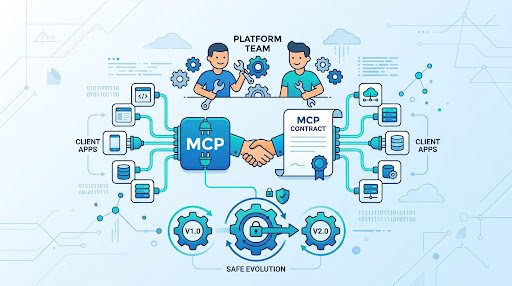
MCP tool contract testing helps platform teams change internal tools without silently breaking the automations, services, and AI assistants that rely on them. The central rule is straightforward: a tool change must remain compatible, introduce a clearly separate contract, or return a failure that callers can interpret safely.
MCP tools are discoverable interfaces with a name, description, input schema, and optional output schema. Because clients and models can discover and invoke them dynamically, those details become part of the interface that downstream systems depend on. MCP also distinguishes protocol-level failures from tool execution errors, giving teams a basis for predictable error handling. MCP tool documentation
The implementation framework is not the hard part. The harder engineering decisions are defining what a tool promises, which identity may invoke it, what happens when a request cannot complete, and how existing consumers will be protected as the tool evolves.
Treat Each Internal Tool as an API Contract
An MCP server may begin with one developer workflow or a small assistant experiment. Once multiple teams use it, its tool definitions become shared infrastructure. Tool names, required fields, response fields, authorization behavior, and side effects can all become dependencies.
For practical governance, define four connected contracts for every shared tool:
- Discovery contract: the tool name, purpose, description, and availability give callers enough stable information to select it.
- Data contract: inputs and structured outputs follow documented JSON Schema rules.
- Authority contract: each invocation is constrained by the authenticated caller and the backend permissions that apply.
- Operational contract: failures and consequential actions have predictable, testable behavior.
This is broader than checking whether a request is valid JSON. A request can be structurally valid while still being ambiguous, unauthorized, unsafe to retry, or incompatible with a workflow that expects a particular meaning.
Define the Contract Before Building the Tool
Keep a compact contract record alongside each tool’s implementation. Review changes to that record as interface changes, not as incidental code edits.
| Contract area | What to define | Why it matters |
|---|---|---|
| Identity | Stable name, owner, lifecycle status, and intended callers | Renames and unclear ownership disrupt discovery and support. |
| Inputs | Schema, required properties, permitted values, defaults, and examples | A new required input can invalidate established callers. |
| Outputs | Structured result fields and examples for normal and unsuccessful outcomes | Consumers may parse fields even when a human can read the response. |
| Authority | Identity requirements, access boundaries, and approval requirements | Tools should not broaden backend access simply because an assistant invokes them. |
| Failure behavior | Protocol or execution failure, safe detail, and caller action | Callers need to distinguish a rejected request from an incomplete operation. |
| Evolution | Compatibility policy, deprecation path, and fixtures | Behavior changes need an explicit migration path. |
MCP uses JSON Schema 2020-12 for tool input and output definitions. Schemas should therefore be treated as executable interface documentation, with examples that show both accepted requests and meaningful results. MCP tools and schemas
Check Meaning as Well as Shape
Schema compatibility and behavioral compatibility are different tests. A response field can remain a string while its meaning changes in a way that breaks automation. An input can remain optional while a changed default alters the action a request performs.
Review every proposed change with two questions:
- Will previously valid requests still validate?
- Will those requests retain their expected meaning, authority boundary, and operational result?
Schema validation answers the first question. The second requires examples, scenario tests, and expectations from consumers that rely on the tool.
Evolve Tools Through Compatible Additions
Compatible additions are usually the least disruptive path: an optional input, an additional optional output field, or a separate new tool. Removing fields, making an existing field required, narrowing accepted values, changing defaults, or materially changing side effects should be considered breaking changes for internal consumers.
Consumer-driven contracts provide a useful pattern for this work. Consumers define the interactions they need, and providers verify those expectations against candidate builds. This makes consumer assumptions executable instead of leaving them undocumented. Consumer-Driven Contracts: A Service Evolution Pattern
For MCP, a consumer may be a Java service, workflow runner, command-line automation, or assistant integration. Each critical consumer can contribute a focused suite covering the requests and responses that its workflow depends on, including important authorization and error paths.
Use Two Levels of Versioning
Protocol compatibility and business-contract compatibility should be managed separately. MCP defines protocol version negotiation and specifies an UnsupportedProtocolVersionError for unsupported versions. MCP versioning and compatibility
That protocol version does not, by itself, describe the meaning of a particular internal tool. A practical policy is to retain a tool name for compatible additions, create a distinct tool such as create_change_v2 when behavior materially changes, and publish a migration destination before retiring the older tool.
Keeping both versions available during a documented deprecation period gives downstream owners time to update. It also makes the available behavior visible to assistants and other consumers rather than relying on a hidden in-place change.
Put Permission Boundaries in the Contract
A schema is not a complete tool contract without an authority model. An assistant may provide another path to a sensitive backend, so a tool must still enforce the permissions that apply to the authenticated requester.
OWASP identifies excessive functionality, excessive permissions, and excessive autonomy as related risks for systems that expose tools to AI agents. Its guidance includes least privilege, identity propagation, complete mediation, output validation, and approval controls for high-impact actions. OWASP LLM06:2025 Excessive Agency
Record these decisions for every tool:
- Whether authorization is based on an end-user identity, service identity, or both.
- Which tenant, project, environment, repository, or other backend boundary applies.
- Which operations are read-only and which have consequential effects.
- Which actions need an approval step before execution.
- Which output fields must be filtered for the caller.
Spring AI’s MCP server support includes transport context facilities for carrying authentication information into tool handling. Its documentation also advises securing HTTP endpoints before exposing tools beyond localhost. Spring AI MCP Server Boot Starter reference
Classify tools by impact. A read-only inventory lookup and a production-changing operation should not receive identical authorization, confirmation, or retry treatment merely because both are available through MCP.
Make Failure Behavior Explicit
Failure handling is a core compatibility concern. A caller that cannot distinguish invalid input, authorization denial, dependency trouble, and an uncertain operation state may take the wrong next action.
MCP separates JSON-RPC protocol errors from tool execution errors. For execution errors, tool results can be marked with isError: true, allowing a model to recognize that the invocation did not succeed and potentially adjust its approach. MCP error handling guidance
Use structured result fields where consumers need stable machine-readable failure information. For example, a team may define an error category, an indication of whether another attempt is appropriate, a safe user action, and a request identifier for support and auditing. The precise vocabulary is an internal contract, so it should be documented and tested rather than inferred from free-form error text.
For tools with side effects, define how callers learn whether work was rejected, completed, or remains uncertain. The important compatibility property is that consumers have a documented path to determine the state of a consequential request without guessing from an error message.
Run Contract Checks in Delivery Pipelines
MCP tool contract testing is most effective as a small set of complementary checks rather than one integration test.
Validate Published Definitions
Verify the tool definitions exposed by a candidate server: expected names, descriptions, input schemas, and output schemas. The official Java SDK supports synchronous and asynchronous server implementations, JSON Schema validation using JSON Schema 2020-12 defaults, runtime invariant checking, and use of the official conformance test suite. Model Context Protocol Java SDK
Fail a release candidate when an expected tool is absent, a schema is malformed, or the published interface no longer matches the contract record.
Maintain Provider Fixtures
For every shared tool, keep fixtures for valid inputs, invalid inputs, authorized calls, unauthorized calls, and representative dependency failures. Assert complete structured output whenever another system relies on it. For human-readable output, test the stable information needed by callers and ensure protected details are not returned.
Verify Critical Consumer Expectations
Run consumer contract suites against candidate server builds. A deployment-oriented consumer might verify that its expected result fields remain available and that a protected action is refused without the required approval state. An incident-oriented consumer might verify that its expected missing-resource response remains distinguishable from a transient backend failure.
These tests protect against semantic changes that provider-only checks may not expose.
Test Authorization as Observable Behavior
Use distinct identities and access boundaries in test cases. Verify that a permitted caller can access only permitted data, that an unprivileged caller cannot gain access through parameters, and that protected actions reject requests that lack their required authorization or approval condition. Test returned data as well as whether an action is allowed.
Exercise Supported Transports
When a service supports more than one MCP transport, test the tool catalog and representative calls through every supported mode. Spring AI documents support for STDIO, SSE, Streamable HTTP, and stateless operation; teams should make the transport modes they support an explicit part of their service policy. Spring AI transport configuration
FAQ
Do all internal MCP tools need version suffixes?
No. A suffix is useful when retaining the existing name would conceal a breaking change in meaning or effect. Compatible additions can remain under the same name when established consumers continue to validate and behave as expected.
Is JSON Schema validation sufficient for MCP tool contract testing?
No. It checks interface shape, but does not establish authorization behavior, protected output handling, operational results, or the meaning of values and defaults. Combine schema checks with scenario tests and consumer expectations.
When should a tool return an execution error?
Use the MCP error model deliberately. Protocol errors concern protocol-level problems. A tool execution error communicates that the invocation was understood but could not complete. The result should give the caller enough safe information to determine its next action.
How can a Java team start without delaying every release?
Begin with tools that cross sensitive boundaries or affect shared workflows. Add a published schema, authorization fixtures, and a small number of critical consumer expectations. Expand the suite as adoption and dependency count increase.
Sources
- Tools – Model Context Protocol
- Versioning and Compatibility – Model Context Protocol
- MCP Server Boot Starter – Spring AI Reference
- Model Context Protocol Java SDK
- OWASP LLM06:2025 Excessive Agency
- Consumer-Driven Contracts: A Service Evolution Pattern
Editorial note: AI assisted with research and drafting. Sources were selected for verification.

Full-Stack Developer & Solutions Architect · Casablanca, Morocco
8+ years building Java/Spring Boot/Angular enterprise solutions. Former Senior Software Engineer at NTT Data and Satec. Authorized Google Workspace and Microsoft 365 Partner for Morocco.