





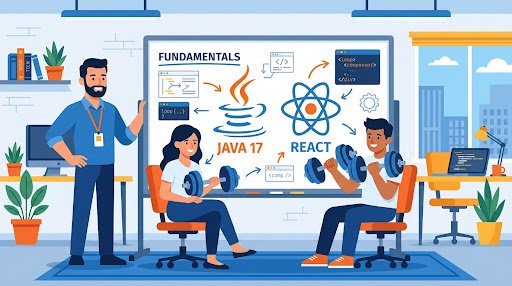
AI coding assistants can speed up routine implementation, but they do not remove a team’s responsibility for the software it ships. Engineering managers should focus less on whether an assistant can generate a Java service or React component and more on whether the engineer receiving that output can explain its behavior, verify its important risks, and change it safely later.
That distinction matters because production ownership depends on judgment. A plausible-looking change may still conflict with an API contract, put state in the wrong place, test an unimportant boundary, or miss a failure case that only becomes visible in the running system. The operating model below keeps AI useful while making human reasoning explicit in delivery, review, and team learning.
For teams developing AI coding assistant developer skills, the durable capability is not simply writing more effective prompts. It is retaining the ability to understand a system, assess generated suggestions, select suitable tests, and diagnose failures. Google’s 2025 DORA report announcement describes AI as an amplifier of a team’s existing strengths and weaknesses, while connecting stable delivery to automated testing, version control, feedback loops, and loosely coupled architecture. DORA’s 2025 report announcement supports treating AI adoption as a team-system concern rather than an individual productivity contest.
Keep a human owner for every change
An assistant can propose code, tests, refactors, and explanations. The engineer opening the pull request remains accountable for deciding whether those proposals belong in the codebase. GitHub cautions that generated code can be inaccurate and should be reviewed and tested, especially in critical or security-sensitive applications. Its guidance also says output should be checked against the repository’s architecture, design patterns, and style. GitHub’s responsible-use guidance for Copilot Chat provides a sound baseline: generated output is input to an engineering decision, not evidence that the decision is correct.
A useful standard is that the author of a change can answer four questions before requesting review: what changed, why the design fits, how it was verified, and what could fail. This standard should apply to both hand-written and AI-assisted work. It avoids creating a separate process for AI while still preventing generated code from becoming opaque.
Use Explain, Verify, Own in pull requests
Add three short prompts to the pull-request template when an assistant materially contributed to the change.
- Explain: Describe the behavior, data flow, and selected boundary. The explanation should make it clear that the author understands the change beyond its syntax.
- Verify: State the tests or checks run and why they address the meaningful risk. Passing generated tests are evidence, but not proof of correctness.
- Own: Identify the most likely failure mode and, when relevant, the rollback, alerting, or diagnostic path.
These prompts should be brief. Their value is that they make assumptions available to reviewers and create a record of the author’s reasoning. Managers do not need a new approval ceremony; they need a consistent expectation that every accepted change has an engineer who can defend it.
Define the fundamentals worth preserving
Assistants can make locally credible code easy to produce. The management challenge is preserving the reasoning that connects a local implementation to the larger system. For Java and Spring teams, that commonly means understanding dependency boundaries, error behavior, data access, API contracts, authorization, and test isolation. For React teams, it means understanding component responsibilities, state ownership, events, rendering behavior, and client-server boundaries.
React’s official learning material identifies components, responding to events, updating state, conditional rendering, lists, and sharing data between components as core concepts. React’s Quick Start can serve as a baseline for the concepts developers should be able to explain even when an assistant created the initial implementation. During review, managers and reviewers can ask who owns a piece of state, what event changes it, and what the UI should do if a request fails.
For Spring applications, design and testability are linked. Spring’s testing documentation notes that well-applied dependency injection makes classes easier to wire and test. Spring Framework testing guidance gives teams a practical review lens: generated code should have understandable dependencies and testable behavior, rather than merely compiling and satisfying a narrow example.
| Engineering judgment | Java/Spring question | React question | Useful AI role |
|---|---|---|---|
| Boundary selection | Does this responsibility fit the controller, service, repository, or integration boundary? | Should this state live here, in a parent, in shared state, or on the server? | Offer alternatives for an engineer to evaluate. |
| Failure handling | What happens when validation, persistence, or a dependency fails? | What happens during loading, error, retry, or stale-result states? | List cases that may require review. |
| Testing | Which test level protects the relevant contract? | Which user behavior or state transition needs evidence? | Suggest cases without choosing the test strategy unexamined. |
| Security and domain logic | Are business and authorization rules enforced at the intended boundary? | Does the client assume a rule that must be enforced by the server? | Raise questions for contextual human review. |
Require a deliberate test boundary
A common failure mode is accepting assistant-generated tests because they appear comprehensive. A test can pass while exercising the wrong layer, replacing an important collaboration with mocks, or missing a contract between components. Spring Boot documents several distinct testing approaches, including application-context tests, focused test slices, and tests against a running server. Spring Boot’s testing reference makes clear that these approaches serve different purposes.
For meaningful Java changes, require a one-sentence test-boundary rationale: “This is a [test type] because it protects [risk or contract].” The rule is intentionally small, but it asks the author to make a decision. A pure transformation may warrant a unit test. A persistence query may require a persistence-aware test. A behavior that crosses HTTP configuration, security, and service code may justify a broader boundary.
Apply the same discipline to React work. Ask authors to name the user-visible result the test demonstrates and the state transition that makes it relevant. “The component renders” is rarely enough context. A statement such as “the form remains unavailable until required data is present” gives reviewers a behavior they can inspect, challenge, and verify.
AI can accelerate test creation by proposing cases and scaffolding setup. The author should still decide which risk matters, what contract is being protected, and whether the test would fail for the defect the team is trying to prevent.
Use review as a judgment practice
Automated review can add another signal, but it should not replace people who understand the product and architecture. GitHub states that Copilot code review can miss issues or make mistakes and must be supplemented with human review. Its documentation also describes repository guidance for coding standards, architecture defaults, and test expectations. GitHub’s Copilot code review documentation supports a layered approach: repository guidance helps tools follow local expectations, while engineers assess context that guidance cannot fully encode.
Review assignments should give more than a small group of senior engineers the opportunity to practice architectural reading. For higher-risk changes, pair a less-experienced reviewer with an experienced reviewer. Ask the newer reviewer to identify the data flow, important invariant, and chosen test boundary before comparing notes. This turns review from passive approval into supervised practice.
Useful review prompts include:
- What invariant must remain true after this change?
- Which dependency or API contract is most likely to drift?
- Where is authorization enforced, and could another path bypass it?
- What input, lifecycle, retry, or concurrent-update case has not been considered?
- Would an on-call engineer have enough context to diagnose a failure here?
OWASP’s guidance is particularly relevant for consequential changes. Its secure code review material says manual review remains necessary for business logic, data flow, complex security controls, and context-specific vulnerabilities. It also emphasizes understanding architecture, requirements, threat models, critical assets, and the impact of changed components. OWASP’s Secure Code Review Cheat Sheet reinforces why a tidy generated diff cannot replace contextual review.
Create regular practice outside urgent delivery
Fundamentals weaken when every task begins with a request for a patch and ends with acceptance of the first workable answer. A ban on AI is not required. Instead, create low-stakes opportunities for engineers to reason before generation and compare implementation choices after delivery.
Run a short recurring discussion using a recently merged, non-sensitive change. Focus on one question: why a dependency belongs at a certain boundary, why a React state variable has its current owner, why a Spring test has its selected scope, or how an error reaches an API consumer. Begin with the existing code rather than a generic lecture. Then use an assistant to propose a different implementation and ask the group to compare the tradeoffs.
Another practical habit is explain-first prompting. Before asking an assistant to implement a change, the engineer writes a compact design note in the task or pull request covering inputs, outputs, dependencies, invariants, and the intended test boundary. The assistant can help turn that note into code, but the human specification remains visible to reviewers. This is useful even when the eventual implementation is small because it exposes assumptions early.
Adopt a lightweight operating model
Do not judge AI adoption primarily by accepted suggestions or lines changed. Those measures do not show whether a team can maintain what it ships. Better operational signals are whether authors can explain production changes, reviewers identify meaningful concerns, tests reflect consciously chosen risks, and incident learning updates the team’s repository guidance.
- Define which changes need an Explain, Verify, Own summary.
- Document local architecture conventions, test commands, security expectations, and generated-file policies in repository guidance.
- Require a test-boundary rationale for behavior-changing work.
- Use AI review as a supplemental signal while retaining human approval for consequential changes.
- Rotate review work so debugging and architectural judgment are practiced across the team.
- Discuss real Java/Spring and React decisions on a recurring basis.
- After an incident, update relevant tests, documentation, or repository guidance with the learned failure mode.
Start with one change to the workflow, such as the pull-request summary and test-boundary rationale. Once that is routine, add review pairing or a recurring technical discussion. The goal is not to slow assisted implementation. It is to ensure the team retains the judgment needed to own the resulting system.
FAQ
Should engineering managers prohibit AI coding assistants for junior developers?
Usually, a stronger approach is supervised use with explicit explanation and verification requirements. Junior engineers need practice reading, debugging, testing, and reviewing code. Assistants can support that practice when their output remains discussable and reviewable.
Which AI coding assistant developer skills matter most?
Prioritize system comprehension, debugging, architecture and boundary selection, test design, secure code review, and the ability to explain tradeoffs. Prompting skill matters when it helps engineers exercise those capabilities rather than bypass them.
How should a Java team review generated Spring tests?
Ask what risk the test addresses and why its boundary is appropriate. Spring provides different testing levels, so the team should choose the level based on the behavior and integration contract it intends to protect.
How can React teams tell whether generated code is understood?
Ask the author to explain component responsibility, state ownership, event flow, error behavior, and the user outcome covered by tests. These questions align with React’s foundational concepts and make hidden assumptions easier to find.
Sources
- Announcing the 2025 DORA Report: State of AI-Assisted Software Development
- Responsible use of GitHub Copilot Chat in GitHub
- About GitHub Copilot code review
- OWASP Secure Code Review Cheat Sheet
- Spring Framework Testing
- Testing Spring Boot Applications
- React Quick Start
Editorial note: AI assisted with research and drafting. Sources were selected for verification.

Full-Stack Developer & Solutions Architect · Casablanca, Morocco
8+ years building Java/Spring Boot/Angular enterprise solutions. Former Senior Software Engineer at NTT Data and Satec. Authorized Google Workspace and Microsoft 365 Partner for Morocco.